 Kasra Vaziri
Product Team Alignment Is the Job AI Can't Do for You
Building got cheap in 2026; agreeing on what to build didn't. Two new surveys show why product team alignment—not shipping speed—is the real constraint.
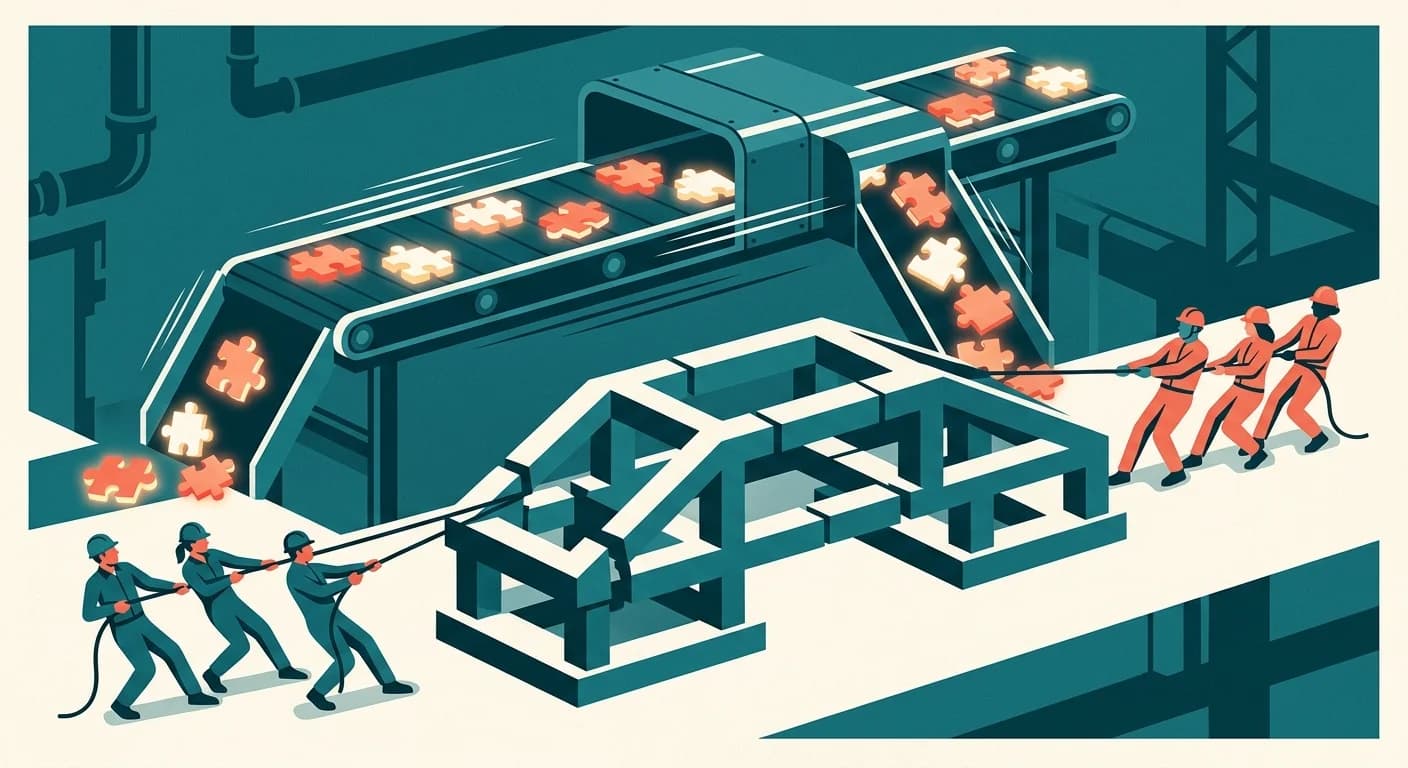
Last quarter I watched two of my engineers pick up what everyone in the room agreed was the same, cleanly-scoped feature. Same doc. Same standup. Same nods. Two weeks later they demoed two different products — one solved the customer's actual problem, the other solved a problem we'd quietly stopped caring about in the spring. Nobody lied. Nobody slacked. They'd each filled the gaps in the spec with a slightly different imagination, and the gaps were bigger than the spec.
The building was fast. The agreeing never happened. That gap — not typing speed, not tooling, not headcount — is where product teams are losing their quarters right now. Call it what it is: product team alignment is the binding constraint in 2026, and the tools that made building cheap don't touch it. If anything, they make its absence more expensive.
Building got cheap. Agreeing didn't.
Two independent surveys this year land on the same uncomfortable spot from opposite ends of the org.
From the product side, Atlassian's State of Product 2026 found that 84% of product teams worry what they're building won't succeed in the market — and, tellingly, 80% don't bring engineers into the process early.
From the engineering side, Luca Rossi's survey of 340 practitioners for The State of Product Development 2026 found that only 27% of engineers say both the problem and what "done" looks like are clear before they start. Sixty percent go back and ask clarifying questions "often" or "almost always." Unclear specs were named the number-one team bottleneck — cited twice as often as anything else on the list.
Read those two together and the picture is blunt: the expensive part of shipping was never the shipping. It's getting a room full of people to arrive at a shared, specific picture of what "good" means before the work starts. We got dramatically better at the first thing and no better at the second.
AI amplifies your clarity — and your fog
Here's the part that should reframe how you think about your tooling budget. Rossi's summary of all that data is one sentence: "AI is an amplifier of whatever you already have."
A team with a crisp shared model of the problem now moves at a frightening clip. A team with a fuzzy one produces fuzzy work faster than ever — more code, more docs, more confidently-wrong drafts to reconcile later. The speed of building went up tenfold. The speed of agreeing went up zero. So the fog stopped being a tax on the work and became most of the cost of the work.
The money side already shows it. Productboard's CPO survey found that 39% of product investments now fail for lack of a clear strategy, up from 25% a year earlier. As one head of product put it there, "speed without direction is just chaos in disguise." You can now generate that chaos in half the time.
Alignment isn't a meeting, and it isn't consensus
Two misunderstandings keep teams stuck here.
The first is thinking alignment is a meeting — a kickoff where everyone nods and no one asks the awkward question. But the nod isn't alignment. The nod is the absence of the questions that would have exposed that you weren't aligned. Those questions don't disappear when the meeting ends; they resurface two weeks later as two different demos. If 60% of engineers have to circle back for clarification after the room broke, the room didn't produce alignment. It produced the appearance of it.
The second is confusing alignment with consensus. Consensus is everyone agreeing on the answer. Alignment is everyone understanding the answer and the reasoning behind it — including the people who'd have chosen differently. You can be fully aligned and still disagree; you commit because you can see the logic, not because you won the argument. Chasing consensus is how you get watered-down features and meetings that never end. Chasing alignment is how you get a team that builds the same thing on purpose.
How to build product team alignment on purpose
As a CPO, I've come to think of manufacturing this clarity as most of the actual job. A few moves that move the needle:
Write the problem and the success criteria before the solution. If only a quarter of your engineers can see what "done" means, that's a leadership failure, not an engineering one. Put the problem and the bar in writing first, and align the team on the problem — not your favorite feature. This is the whole argument for treating your roadmap as a list of problems, not features: a problem invites the team to think; a pre-baked feature invites them to nod and diverge.
Put engineers in the room while it's still clay. Eighty percent of teams don't, and it's the cheapest mistake to fix. The engineer finds the hidden dependency, the impossible edge case, the version that's a tenth of the work — but only if you invite them before the spec is frozen. Early is uncomfortable because the idea is still soft. That's exactly when it's cheap to reshape.
Make "done" and "good" testable, not vibes. Not "improve onboarding" but "a new user reaches first value in under five minutes, and we'll know from activation rate." Vague success criteria are precisely where two imaginations split. A criterion you can't test is a criterion two smart people will interpret two ways.
Name who decides. Alignment is not endless discussion; that's just consensus theater with a deadline. Say out loud who owns the call, gather the dissent honestly, then decide and commit. Disagree-and-commit beats a unanimous vote that took three weeks to fake.
Let experiments break the tie. Only 60% of teams experiment regularly, and 40% barely at all — which means most disagreements get settled by whoever is most senior or most stubborn. When smart people stay split on a bet, stop arguing and run the smallest test that would change one of your minds. Good strategy is deciding what not to build; a cheap experiment often tells you which door to close.
The scarce skill is agreement
The thing that got scarce in 2026 isn't the ability to produce. The machine will produce all day — code, PRDs, mocks, roadmaps, whatever you point it at. What got scarce is the ability to produce agreement: a group of people building the same thing, on purpose, toward a bar they can all actually see.
AI can draft the spec. It cannot make your team mean the same thing by it. That translation — from a document everyone nodded at to a shared intention everyone acts on — is still the work, and it's the work that decides whether all that cheap velocity points somewhere or just scatters.
So before you ask how much faster your team can ship this quarter — a question you already know the flattering answer to — ask the harder one. If two of your people picked up the same spec tomorrow, would they build the same thing? If you're not certain, that's your bottleneck. And no model on the market is going to fix it for you.